We’re all aware of chanceries 20 years ago harassing their indult parishes for not teaching NFP (because of an abundance of children, not a dearth). But, until you visit your first TLM parish, you could be fooled into thinking we had cured Down Syndrome because you don’t see those children at the Novus Ordo parishes. Does Jones think these people are genetically superior the way the homosexuals do? Similarly, these parishes have historically shown no interest in Međugorje Pilgrimages nor TOB lectures. Is Jones underestimating the supernatural effects of the Mass which become most apparent when people leave and go back to dying their hair blue, contracepting, and acting like Jews?
And why is he still hung up on the bizarre notion that traditionalism is a divisive movement based in New York with its strings being pulled by Jews? Take a look at a map of Ecclesia Dei parishes and you’ll see a black hole in the New York Metropolitan area precisely because the Jews have let the hierarchy know they don’t want it. Only this year did the gay bishop of Brooklyn permit a Latin Mass parish (ICKSP) to be established and that coincided with prohibiting it in the two diocesan parishes that had it occasionally. https://onepeterfive.com/new-survey-shows-disparity-of-beliefs-between-latin-mass-novus-ordo-catholics/
For the Boomers, pointing out the correlation between rites of worship and belief is pissing on a third rail the way acknowledging the existence of a JQ was for their fathers. All Boomers? Of course not, that would be a category error. We all know Boomers who wouldn’t go near a TLM who, nevertheless, are praying in front of abortuaries every week. Many of these people blew their life’s savings on a trip to Međugorjeand they love talking about taking a century to unpack the mysteries of TOB like George Weigel’s pet parrot.
Edit: it’s been a long time coming, but late is better than never. We always said Thug was starting to name them in recent times. It’s a bit disappointing to see him sort of endorse Nick Fuentes, the pedo promoter and defender,and an anti-social weirdo who doesn’t understand Catholicism or believe it. When Fuentes’ producer wanted everyone pray rosary with the Groypers at a gathering, he tried to protest and then moped over to a corner to play with his phone while everyone else prayed.
He’s a lot like Milo, but at least Milo is better at paying lip service to Catholicism and playing church. Fuentes also didn’t seem to assist much at Mass during Covid. It’s doubtful he goes regularly to Mass at all, because he often plays computer games on Sunday mornings.
These personalities don’t even put much effort in their facade!
I don’t know why people put so much stock in these lame influencers, but it is nice to see Thug turning over a new leaf so to speak.
Everyone interested in objective (if unpopular) truth must read this book republished by @EMichaelJones1
Thanks for this republication, and apologies if I gave hasty opinions on the matter six or seven years back
One of the frequently quoted historical reference points for chronologicalizing the events reported in the Gospel concerns the year of the death of King Herod the Great: the year 4 BC, at least according to many authors.
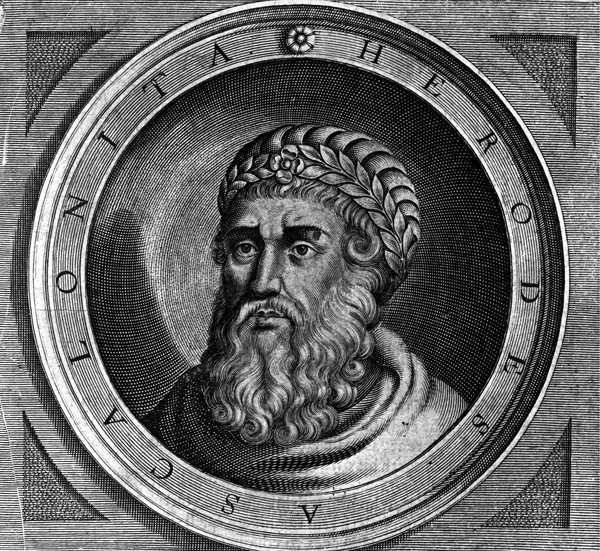
Herod the Great
This year we owe to the writings of Flavius Josephus, who, however, never expressly names them. It is derived from the reigns of Archelaus, Philippos and Antipas, the heirs of Herod. But Flavius Josephus himself provides at least a dozen clues that contradict and render the year useless as Herod's year of death. For example, it was not uncommon to reckon with the successor's reigning years as well as the time when the office was held, but the old king was still alive.
Amazingly, many writers today write that "Herod certainly died in the year 4 BC." They do so with such confidence in Flavius Josephus that they simply ignore many other of his statements, which are much more precise. Flavius Josephus wrote that Herod died at the age of seventy. Similarly, at the age of just 15, Herod was appointed by his father Antipater to be the administrator of Galilee, after he had come to power from Pompey, after the Romans conquered Jerusalem in 63 BC.
We also know that at the time of the Battle of Actium, in September 31 BC, Herod was in the seventh year of his kingship. According to Jewish Antiquities, his reign lasted 37 years, 30 to 31 years after the Battle of Actium. We know that Herod, in the eighteenth year of his reign, after the visit of Emperor Augustus to Syria, for which the Roman historians handed down to us the year 19 BC, resolved to rebuild the temple (the 15th year of his reign, according to the records) in the History of the Jewish War , in which Herod's reign is given as 34 years). In short, in the year 4 BC, Herod was still alive.
Astronomy gives justice to the Evangelist Luke
Astronomy is also in this case an effective tool for determining the timing of historical events. It provides both Flavius Josephus as a historian, and Luke as an evangelist justice, but to the detriment of many modern authors. Flavius Josephus wrote that Herod died about two weeks after a spectacular lunar eclipse and that his funeral took place before the subsequent Jewish Passover. The records of NASA allow us to calculate the exact date of the lunar eclipses of that time and eliminate those that were invisible in Palestine.
Those who insist that Herod died in the year 4 BC look at the darkness of March 13 (according to the Julian calendar) of that year. At that time the 14th Nisan fell on the 12th of April, so 29 days later. After all, however, what Flavius Josephus reports for that period, the time span is too short to be that date. An often overlooked detail: the 13th of March would have been the 14th Adar, a feast day (Purim) associated with the 13th Adar, the day of Nicanor, a feast day since the times of the Maccabees.
Flavius Josephus testifies that just a few days before, two rabbis had instigated an anti-Roman uprising, destroying the gilded eagle that Herod had placed on the outside of the Jerusalem temple. For security reasons, Herodes preferred to bring the two rabbis outside Jericho to Jerusalem, where he was in the spa to heal his physical ailments. He had them burned alive on the very day of darkness ( Jewish Antiquities , chapter XXVII).
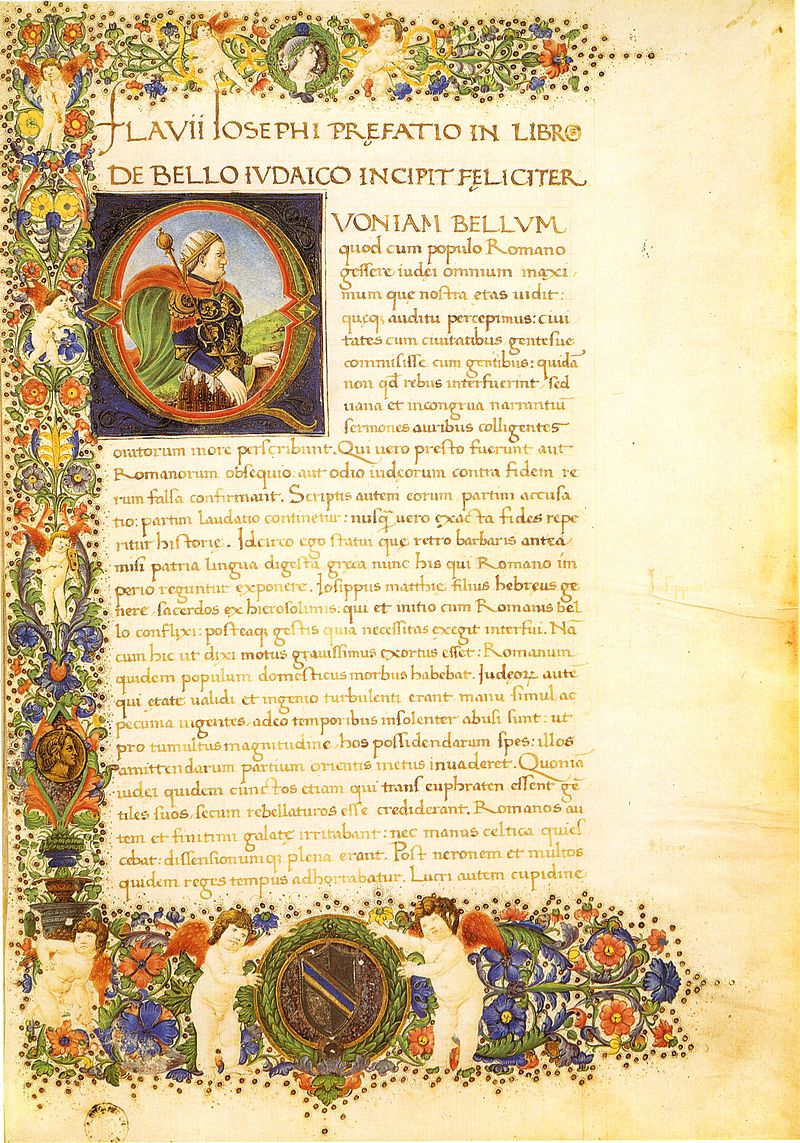
Flavius Josephus, The Jewish War
Considering the great respect of the Jews for holy days, which Herod always kept disparaging, but no court could have been found, not even an unlawful one, to pass a verdict on a religious feast (Est 9,17--18), let alone against two well-known rabbis. The entire population would have been scandalized about it. However, Flavius Josephus reported that it was not just any court, but the Highest Court of the Jews, the right-wingers par excellence. He also recalled that Archelaos (co-regent of Antipas and Philippos since the year 4 BC), because of the persistent criticism of the judgment, expressly justified that it was done "in accordance with the law." Even with Jesus, the "law" endeavored to accelerate his execution so that no feast day would be profaned.
The 14th Adar may not have been the date of the lunar eclipse and therefore it is not the year 4 BC that interests us. Herod, an Idumaean, would not have had two rabbis burned on a day when Haman was burned according to the ancient tradition of the Purim festival.
If there are any doubts: Flavius Josephus lists for the period after this "impossible execution" and before the Passover, a series of events that occurred before Herod's death (which occurred about two weeks after the lunar eclipse). However, the dates are incompatible with the few missing days until the 14th Nisan.
So it must have been another lunar eclipse. According to NASA directory, two especially would be in question. The first occurred on the 10th of January of the year 1 before Christ, the second on the 29th of December of the same year. In both cases there would be sufficient time to accommodate all the events that Flavius Josephus mentions between the darkness and the subsequent Passover. A Jewish document, Megillat Taanith, which dates back to the destruction of the temple in the year 70 AD, has been handed down to us. The scrolls contain a list of Jewish festivals. In it are two dates without further information, on which it was forbidden not to celebrate: one is the 7th Kislev, the other of the 2 Shevat.
M. Moise Schwab, through a detailed and intricate study in the 2nd Shevat, pinpointed the death of Herod, exactly two weeks after the lunar eclipse of December 29, the 14th of January of the year 1 AD, according to today's calendar. The lunar eclipse came exactly at dusk, so that everyone could see it. Herod, born 70 BC, ruler since the year 37 BC, was 70 years old, and had ruled 37 years according to the specifications of the Jewish Antiquities. Jesus was born about a year before, at the end of the year 2 BC. Everything fits, at least for those who are willing to take a close look.
Text: Ruggero Sangalli / NBQ Translation: Giuseppe Nardi Pictures: Wikicommons